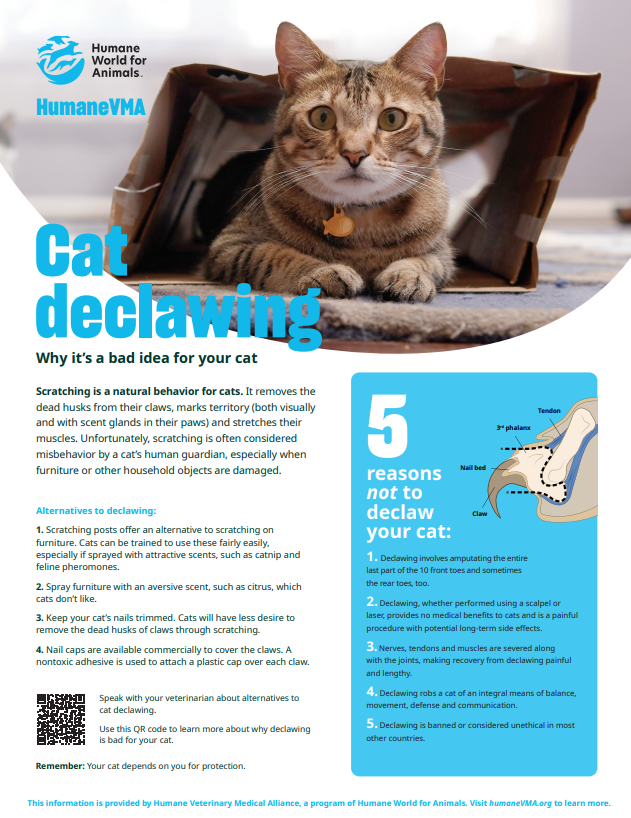
Declawing
Scratching is a normal and necessary feline behavior. Cats scratch to remove the outer nail sheath, stretch their bodies, mark territory visually and with scent, and regulate emotion. Removing a cat’s claws removes part of their natural anatomy and behavior.
What Is Declawing?
Declawing (onychectomy) is not simply nail removal. It is a surgical amputation of the last bone of each toe (the third phalanx).
Because the nail’s growth center is embedded within this bone, the entire bone must be removed to prevent regrowth. This means the procedure removes bone, nerves, tendons, ligaments, blood vessels, and the joint capsule.
This is considered a major surgical procedure requiring general anesthesia, multimodal pain management, and structured post-operative care.
Not a Medical Necessity
Declawing is not medically necessary for the cat. It is performed to address scratching behavior, which is a normal and biologically driven activity.
Leading animal welfare and veterinary organizations strongly discourage elective declawing.
Documented Risks
As with any amputation procedure, risks include:
- Anesthetic complications
- Hemorrhage
- Infection
- Acute and chronic pain
- Nerve damage
- Bone fragment regrowth
Because claws are part of a cat’s balance and weight distribution system, removing them permanently alters biomechanics and gait.
Legal & Welfare Considerations
Declawing has been banned in multiple U.S. states and numerous municipalities, and it is prohibited in many countries worldwide due to animal welfare concerns.
Modern veterinary medicine aims to protect normal feline anatomy whenever possible.
Indoor Living
Declawed cats are at a significant disadvantage if allowed outdoors. Without claws, they cannot defend themselves or climb to escape danger. For this reason, declawed cats must remain strictly indoors.
Our Position
Declawing permanently alters a cat’s anatomy for a behavior that is natural and manageable. We do not support declawing and strongly encourage guardians to address scratching behavior through environmental and behavioral solutions rather than surgical amputation.
Key Takeaway
Declawing is an amputation procedure, not routine nail care. Scratching is normal. With appropriate guidance and setup, destructive scratching can be managed without surgery.
Need support?
Contact us at info@simplycats.org.