Microchip Information
A microchip is a small chip implanted just under your cat’s skin, usually between the shoulder blades. It contains a unique identification number that is linked to your contact information through a microchip registry. Veterinary clinics and animal shelters can scan the chip to identify your cat and help reunite lost pets with their owners.
All cats adopted from Simply Cats are microchipped and registered at the time of adoption.
Please note: A microchip is not a GPS tracker and does not show your cat’s location. It is a permanent form of identification only.
Simply Cats Alumni Microchips
Cats adopted from Simply Cats are microchipped through 24PetWatch, now connected with PetPlace.
You can use their registry to update your contact information and report your cat as lost if needed.
Phone: 1-866-597-2424
Website: www.petplace.com
When Should You Update Your Microchip Information?
A microchip only works if the information connected to it is accurate. To ensure your cat can always find its way back to you, update your cat’s microchip record anytime you:
- Move to a new address
- Change your phone number
- Change your email address
- Privately rehome your cat
- Need to update emergency contact information
Not Sure Which Microchip Company Your Cat Is Registered With?
If you don’t know your cat’s microchip number or the company it is registered with, contact the veterinary clinic, shelter, or rescue where you adopted your cat.
If you have the microchip number but are unsure which registry manages it, use the AAHA Microchip Registry Lookup Tool.
If Your Cat Is Lost
If your cat goes missing, follow the steps in our Lost or Found Cat guide, which includes reporting your cat as lost through the microchip registry and verifying your contact information.
If your cat is found and scanned, the microchip can help connect them back to you.
If you’ve adopted your cat from Simply Cats and have questions about your cat’s microchip, contact us at
adoptions@simplycats.org.
Household Hazards
Cats are naturally curious and capable of squeezing into small spaces, chewing unusual items, and climbing where they shouldn’t. A quick “cat-level” safety check of your home can prevent many emergencies.
Common Household Hazards
- Strings and linear objects: Yarn, dental floss, thread, ribbon, rubber bands, fishing line, and similar items can cause life-threatening intestinal injury if swallowed. Store securely out of reach.
- Cords and blinds: Secure blind cords and drapery pulls to prevent entanglement. Cover or conceal electrical cords to prevent chewing.
- Appliances: Keep washer, dryer, and dishwasher doors closed, and always check inside before starting the appliance. Cats may climb inside and become trapped.
- Cabinets and cleaners: Use childproof latches where chemicals, medications, or small objects are stored.
- Candles and open flames: Never leave burning candles unattended. Cats can ignite their fur by brushing past them.
- Windows and balconies: Check that screens are secure. Cats can push through loose screens and fall.
Toxic Substances
Many common plants, foods, and household products are toxic to cats. Always research unfamiliar items before bringing them into your home.
For a comprehensive and regularly updated list of toxic plants and substances, visit the ASPCA Animal Poison Control website.
Common Toxic Plants
- Lilies (extremely dangerous, even small exposures)
- Poinsettias
- Oleander
- Azalea
- Dieffenbachia
- Holly
- Mistletoe
Common Toxic Household Items
- Mothballs
- Fabric softener sheets
- Batteries
- Tobacco products
Common Toxic Foods
- Onions
- Garlic
- Chocolate
- Coffee grounds and caffeine
- Macadamia nuts
- Yeast dough
Holiday Safety
- Secure Christmas trees and avoid tinsel, ribbon, ornament hooks, and exposed wiring.
- Keep candy and chocolate out of reach.
- Avoid seasonal plants like poinsettias, holly, and mistletoe.
If you think your pet may have ingested a potentially poisonous substance, immediately contact the ASPCA’s Poison Control at (888) 426-4435 (available 24 hours a day, 365 days a year) or your veterinarian.
Need support?
Contact us at info@simplycats.org.
Long-Haired Cat Care
Not all cats have the same grooming needs. Coat length and texture determine how much maintenance is required.
Short-haired cats are often able to keep their coats in good condition through normal self-grooming. Long-haired cats, however, have finer, denser fur that tangles more easily and can trap loose hair close to the skin. Without regular brushing, this can quickly turn into painful mats.
Routine grooming helps prevent matting, reduces hairballs, and allows you to monitor your cat’s skin and body condition.
Why Daily Grooming Helps
- Removes dirt and loose hair
- Distributes natural skin oils for coat health
- Prevents tangles and mats
- Reduces hairballs
- Minimizes shedding in the home
Start Slowly
Choose a calm, familiar location. Keep grooming tools nearby and pair sessions with treats or gentle praise.
Begin with short sessions, 2 to 3 minutes long, when your cat is relaxed, such as after eating or playing. Gradually increase the duration as your cat becomes more comfortable.
Be Gentle & Methodical
Use a soft brush and work from head to tail in the direction of fur growth.
Follow with a wide-toothed comb to address common tangle areas:
- Behind the ears
- Under the chin
- Inside the front legs
- Along the belly
Never cut out mats with scissors. A cat’s skin is thin and can be easily injured. Severe matting should be addressed by a professional groomer or veterinarian.
When Matting Becomes a Medical Issue
Severe matting is more than a grooming concern. Tight mats pull continuously on the skin, which can cause discomfort, restricted movement, and bruising beneath the surface.
Mats can also trap moisture, debris, and bacteria against the skin. This may lead to skin infections, sores, hot spots, or hidden wounds that are not visible until the mat is removed.
If mats are large, tight to the skin, or causing changes in behavior such as irritability, decreased mobility, or reluctance to be touched, seek veterinary or professional grooming care promptly.
Preventive brushing is far safer and less stressful than removing established mats.
Watch for Stress Signals
If your cat becomes tense, flicks their tail sharply, growls, or tries to leave, pause the session. End on a positive note and try again later.
Grooming should feel predictable and safe. Starting when cats are young helps build lifelong tolerance, but older cats can learn through gradual, positive experiences as well.
Key Takeaway
Short, consistent, and positive grooming sessions prevent bigger problems later. Go slowly, respect your cat’s limits, and build comfort over time.
Need support?
Contact us at info@simplycats.org.
Declawing
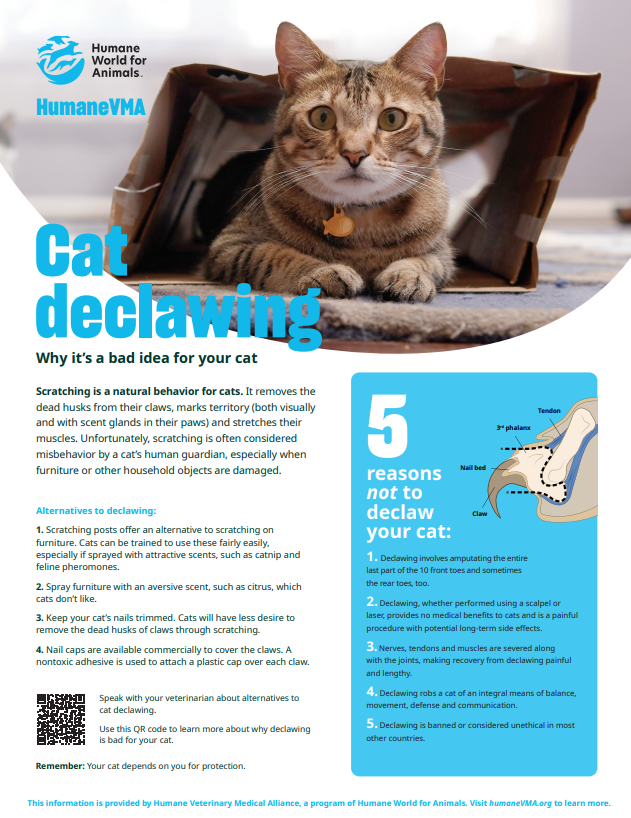
Scratching is a normal and necessary feline behavior. Cats scratch to remove the outer nail sheath, stretch their bodies, mark territory visually and with scent, and regulate emotion. Removing a cat’s claws removes part of their natural anatomy and behavior.
What Is Declawing?
Declawing (onychectomy) is not simply nail removal. It is a surgical amputation of the last bone of each toe (the third phalanx).
Because the nail’s growth center is embedded within this bone, the entire bone must be removed to prevent regrowth. This means the procedure removes bone, nerves, tendons, ligaments, blood vessels, and the joint capsule.
This is considered a major surgical procedure requiring general anesthesia, multimodal pain management, and structured post-operative care.
Not a Medical Necessity
Declawing is not medically necessary for the cat. It is performed to address scratching behavior, which is a normal and biologically driven activity.
Leading animal welfare and veterinary organizations strongly discourage elective declawing.
Documented Risks
As with any amputation procedure, risks include:
- Anesthetic complications
- Hemorrhage
- Infection
- Acute and chronic pain
- Nerve damage
- Bone fragment regrowth
Because claws are part of a cat’s balance and weight distribution system, removing them permanently alters biomechanics and gait.
Legal & Welfare Considerations
Declawing has been banned in multiple U.S. states and numerous municipalities, and it is prohibited in many countries worldwide due to animal welfare concerns.
Modern veterinary medicine aims to protect normal feline anatomy whenever possible.
Indoor Living
Declawed cats are at a significant disadvantage if allowed outdoors. Without claws, they cannot defend themselves or climb to escape danger. For this reason, declawed cats must remain strictly indoors.
Our Position
Declawing permanently alters a cat’s anatomy for a behavior that is natural and manageable. We do not support declawing and strongly encourage guardians to address scratching behavior through environmental and behavioral solutions rather than surgical amputation.
Key Takeaway
Declawing is an amputation procedure, not routine nail care. Scratching is normal. With appropriate guidance and setup, destructive scratching can be managed without surgery.
Need support?
Contact us at info@simplycats.org.
Managing Allergies to Cats
Many people with mild to moderate cat allergies successfully live with their pets. With medical guidance and environmental management, symptoms can often be reduced to a manageable level.
Start with Proper Testing
Consult an allergist for formal testing. Many people are sensitive to multiple allergens, not just cats. Proper testing can help determine what specific cat proteins your body is reacting to.
Reducing overall allergen load in the home often improves symptoms significantly.
Understanding Cat Allergies
Most cat allergies are triggered by a protein called Fel d 1, which is produced primarily in a cat’s saliva and skin glands.
When cats groom, this protein spreads onto their fur and skin. As saliva dries, microscopic allergen particles become airborne and settle on walls, furniture, carpets, and clothing.
People are not allergic to cat hair itself. They are reacting to proteins carried on dander and fur.
Allergic responses vary widely between individuals. Some people are highly sensitive to very small amounts of allergen, while others tolerate higher levels. There are no truly hypoallergenic cat breeds, and even hairless cats produce allergenic proteins.
Medical Management
Treatment options may include antihistamines, nasal steroid sprays, or immunotherapy (allergy shots). Work with your allergist or primary care provider to determine what is appropriate for your situation.
Create an Allergy-Reduced Zone
Designate at least one room, ideally the allergic person’s bedroom, as a pet-free space.
- Keep the door closed consistently.
- Use HEPA air purifiers.
- Consider allergen-impermeable mattress and pillow covers.
Reduce Allergens at the Source
Some cat foods are now formulated to help reduce the amount of active Fel d 1 present in a cat’s saliva and dander. For example, Purina Pro Plan LiveClear has been shown in studies to reduce active Fel d 1 levels in cat hair and dander. While this does not make a cat non-allergenic, lowering the overall allergen load in the home may help reduce symptoms for some individuals, especially when combined with environmental management strategies.
Reduce Environmental Allergen Load
- Use HEPA air purifiers in main living areas.
- Vacuum frequently with a HEPA-filter vacuum.
- Wash bedding, couch covers, curtains, and pet bedding regularly.
- Minimize dust-trapping materials such as heavy drapes and carpeting when possible.
- Avoid strongly scented products that may further irritate airways.
Bathing and Grooming
Regular grooming may help reduce surface allergen levels. If bathing is tolerated, use only cat-safe, unscented, non-medicated shampoos and follow veterinary guidance.
Bathing reduces surface allergens temporarily and must be repeated regularly to maintain the effect.
Important Considerations
If someone in the household has severe or life-threatening asthma triggered by cats, careful medical guidance is essential before bringing or keeping a cat in the home.
For many families, a combination of medical treatment, environmental control, and realistic expectations allows them to successfully live with cats despite mild to moderate allergies.
Key Takeaway
With accurate diagnosis and a structured management plan, many people are able to safely and comfortably share their homes with cats.
Need support?
Contact us at info@simplycats.org.